Material reflectance libraries
Every material reflects light differently depending on its chemical composition and structure. A spectral library is a collection of those reflectance spectra, measured on known samples, and it's what you compare image spectra against to identify materials. See hyperspectral signatures for how that comparison works, and remember to resample library spectra to Dragonette's bands before you compare.
USGS Spectral Library
The United States Geological Survey's Spectral Library Version 7 (splib07) holds spectra for close to 2,500 samples, from the ultraviolet to the shortwave infrared. Minerals are its core, and it also covers soils, vegetation, liquids, organic compounds including hydrocarbons, and artificial materials. You can search and download spectra on the site.
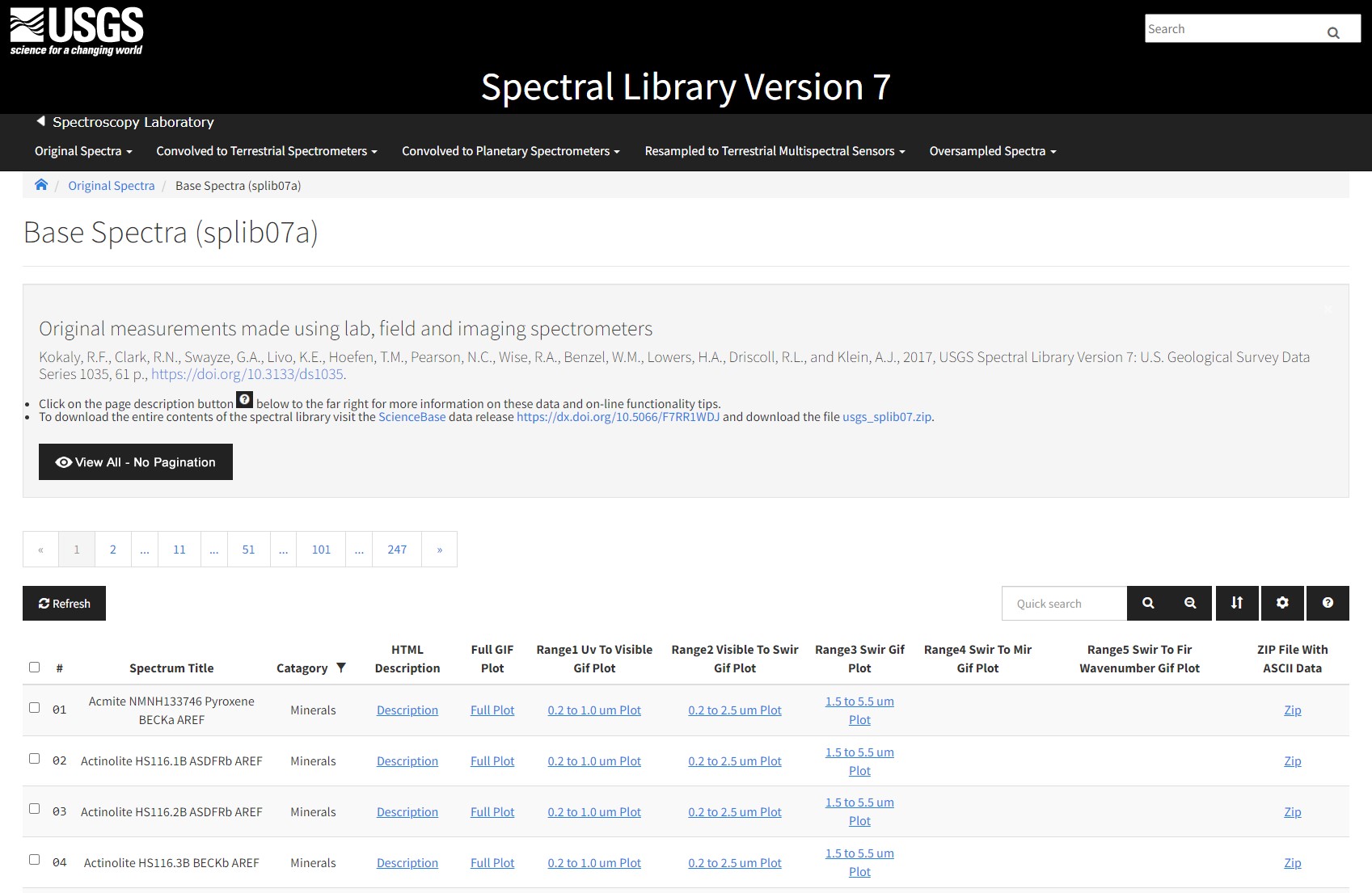
The USGS Spectral Library Version 7 search page.
ECOSTRESS Spectral Library
The ECOSTRESS Spectral Library from NASA JPL contains over 3,400 spectra of natural and human-made materials. It incorporates three earlier libraries, from Johns Hopkins University, JPL, and the USGS.
Urban surfaces spectral library
The University of Reading's London Urban Meteorological Observatory has published a spectral library focused on urban materials.
OpenSpecLib
OpenSpecLib is an open source project that packages the USGS, ECOSTRESS, and EcoSIS libraries as Parquet files, so you can load them straight into Python. The rare earth elements tutorial uses it to pull a USGS reference spectrum and resample it to Dragonette's bands.